
Redline Report: Working Together When the World Feels Divided

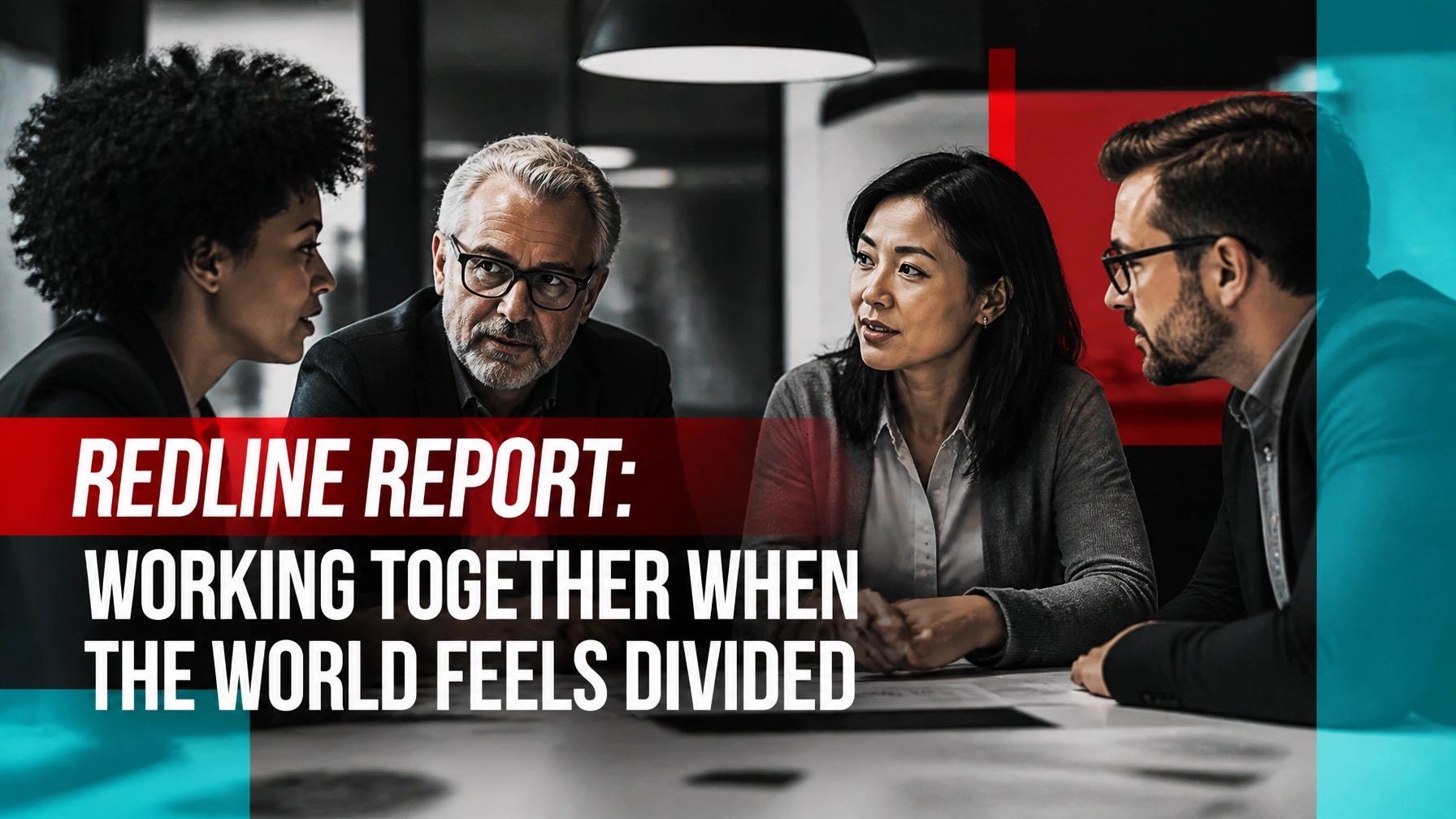
Redline Report: Working Together When the World Feels Divided
The biggest leadership challenge this week may not be artificial intelligence.
AI is still part of the story. Layoffs, automation, middle-management disruption, and algorithmic decision-making are all adding pressure inside organizations.
But the larger story is more human.
People are trying to do good work while carrying more uncertainty than ever: political division, economic pressure, job insecurity, mental health strain, hybrid-work tension, and a growing suspicion that many “strategic transformations” are really just cost-cutting with better branding.
That’s where leadership matters.
Not because leaders can remove all the uncertainty. They can’t.
Leadership matters because someone has to protect the conditions where people can still trust one another, listen to one another, disagree without contempt, and keep doing meaningful work together.
1. Political Division Is Coming to Work
As the 2026 midterm elections approach, business leaders are facing a familiar but intensifying challenge: political polarization doesn’t stop at the office door. Harvard Business School notes that corporate political activity has become risky because any public position can draw criticism from employees, consumers, activists, partisans, or even government actors.
Source: Harvard Business School , https://www.hbs.edu/bigs/can-companies-safely-participate-in-2026-midterm-elections
This does not mean leaders should ban all political conversation. That usually backfires or drives tension underground. The real challenge is helping people work together when they do not see the world the same way.
Keep It Human Insight:
The goal is not forced agreement. The goal is respectful disagreement without letting the workplace become another battlefield. Leaders don’t need to referee every opinion. They do need to protect the dignity of every person in the room.
Leaders do need to carefully consider their own political expressions. It’s not that you shouldn’t have your own political views, but more than ever you’ve got to take care not to let those views diminish your effectiveness as a leader. Like it or not, your words are amplified. Be sure you’re not alienating your people or driving the wedge even deeper.

2. Employees Are Uncomfortable Talking About Politics , But They’re Talking Anyway
Gartner reported that 47% of U.S. employees feel uncomfortable discussing political or social opinions with coworkers. Gallup has also found that political conversations at work can land very differently depending on employee engagement: engaged employees are less likely than actively disengaged employees to feel uncomfortable because of political discussions.
Sources:
Gallup , https://www.gallup.com/workplace/651747/managers-navigate-polarized-workplace.aspx
That’s an important distinction. The problem is not only politics. The problem is the strength of the relationship before the disagreement begins.
In a healthy culture, people can sometimes disagree and keep working together. In a weak culture, even small differences can become personal.
Keep It Human Insight:
Political tension exposes the culture that already exists. If trust is strong, disagreement can be handled. If trust is thin, everything feels like a threat. Leaders who wait until conflict erupts are already late.
3. Global Engagement Hits a New Low
Gallup’s 2026 State of the Global Workplace report found that global employee engagement fell to 20% in 2025, its lowest level since 2020. Gallup estimates the cost of low engagement at about $10 trillion in lost productivity.
Source: Gallup , https://www.gallup.com/workplace/349484/state-of-the-global-workplace.aspx
That number is enormous, but the human reality behind it is even more important. Disengagement is often treated as an attitude problem. More often, it is a connection problem.
People disconnect when they no longer feel seen, trusted, included, or connected to a purpose that matters.
Keep It Human Insight:
Disengagement is not always laziness. It can be valuable feedback. If people are withdrawing, leaders need to ask what they are withdrawing from: confusion, pressure, cynicism, poor communication, weak relationships, or work that no longer feels meaningful.
4. Burnout Is Not a Wellness Problem. It’s a Leadership Signal.
The 2026 NAMI-Ipsos Workplace Mental Health Poll found that 7 in 10 employees report feeling stressed about the state of the world, while 30% report feeling “very stressed,” an 11-point increase since 2024. NAMI also reported widespread burnout, with one in four employees saying they had considered quitting because of the impact of work on their mental health.
Source: NAMI , https://www.nami.org/research/publications-reports/survey-reports/2026-nami-ipsos-workplace-mental-health-poll/
This is not something leaders can solve with a meditation app and a casual “take care of yourself” email.
Burnout is often a design problem. Too much pressure. Too little clarity. Too many priorities. Too few honest conversations. Too much change without enough support.
Keep It Human Insight:
You cannot “wellness program” your way out of an unhealthy work design. When too many good people are exhausted, the system is telling leaders something they need to hear.

5. The Efficiency Paradox: Cutting People to Fund the Future
AI-driven restructuring remains a major part of the uncertainty story. Reuters reported that LinkedIn was planning to cut about 5% of staff as part of broader tech-sector restructuring. Other recent reports point to companies using AI transformation as part of the rationale for workforce reductions.
Source: Reuters , https://www.reuters.com/business/world-at-work/linkedin-is-planning-lay-off-5-staff-latest-tech-sector-cuts-source-says-2026-05-13/
The danger is not that leaders are looking for efficiency. They should.
The danger is when efficiency becomes the only visible value. When people believe the organization sees them primarily as a cost to be reduced, trust collapses. And once trust collapses, the people who remain are less likely to take risks, challenge bad ideas, or contribute their best thinking.
Keep It Human Insight:
Efficiency matters. But efficiency without humanity is subtraction, not strategy. Leaders may save money and spend trust. That’s a bad trade.
6. The Middle Layer Is Under Pressure
Middle managers are increasingly caught between executive pressure and employee anxiety. Deloitte has highlighted the ongoing debate about the future value of middle managers, noting research that predicted some organizations would use AI to flatten structures and eliminate significant portions of current middle-management roles.
Source: Deloitte , https://www.deloitte.com/us/en/insights/focus/human-capital-trends/2025/future-of-the-middle-manager.html
This is where leaders need to be careful.
Yes, some reporting, coordination, and administrative work can be streamlined. But middle managers are not just task routers. At their best, they are coaches, translators, mentors, culture carriers, and early-warning systems.
If organizations hollow out the middle too aggressively, they may also hollow out the leadership pipeline.
Keep It Human Insight:
The middle layer is where much of leadership is learned. If we automate or eliminate the work where people practice judgment, mentoring, conflict resolution, and accountability, who exactly are we preparing to lead next?

7. Return-to-Office Is Really a Trust Conversation
The return-to-office debate continues because it is not just about location. It is about trust, autonomy, fairness, collaboration, and control. Gallup’s hybrid-work data shows that among remote-capable employees, a majority prefer hybrid work, about one-third prefer fully remote work, and fewer than 10% prefer fully on-site work.
Source: Gallup : https://www.gallup.com/401384/indicator-hybrid-work.aspx
That does not mean every organization should be fully remote or hybrid. Some work benefits from physical presence. Some teams need more in-person rhythm. Some roles simply cannot be done remotely.
But leaders need to be honest about the reason.
“Come back because we said so” is not a strategy. “Come back because we need to rebuild trust, mentor younger employees, solve problems faster, and strengthen relationships” is at least a conversation.
Keep It Human Insight:
If presence matters, explain why. If collaboration matters, design for it. If trust is broken, an office badge swipe won’t fix it.
8. Culture Champions Matter More in Uncertainty
Russell Reynolds has emphasized the importance of identifying “culture champions” during uncertain times: the people inside an organization who reinforce values, model behavior, and help others stay connected when the formal strategy is in flux.
Source: Russell Reynolds Associates : https://www.russellreynolds.com/en/insights/reports-surveys/leadership-through-uncertainty
This matters because culture is not what leaders announce. Culture is what people experience.
In uncertainty, employees watch the informal leaders as much as the formal ones. They watch who stays calm. Who listens. Who helps. Who tells the truth. Who protects the mission without sacrificing the people.
Keep It Human Insight:
Do not rely on the C-suite to be the only source of stability. Every organization has people others already trust. Inspire them. Empower them. Guide them. Then let them help carry the culture.
9. Civic Responsibility Without Workplace Combat
Harvard Business School’s recent analysis suggests that while partisan corporate political activity can be risky, nonpartisan civic participation may be a safer and more constructive path for organizations. Encouraging voting, giving people time to participate, and supporting civic engagement does not require turning the workplace into a campaign headquarters.
Source: Harvard Business School : https://www.hbs.edu/bigs/can-companies-safely-participate-in-2026-midterm-elections
That distinction is important.
Leaders can support civic responsibility without dragging the company into partisan conflict. They can remind people that citizenship matters while also making clear that respect inside the workplace is not optional.
Keep It Human Insight:
A company does not have to take sides in every political battle to stand for human dignity, respectful dialogue, and responsible participation. Leaders can support democracy without weaponizing the workplace.
10. Optics Over Substance Is Getting Easier to Spot
This may be the thread connecting all the others.
Employees can tell when leaders are performing concern instead of practicing it. They can tell when “transformation” means layoffs. They can tell when “flexibility” means control. They can tell when “culture” means slogans. They can tell when “listening” means a survey no one plans to act on.
In uncertain times, credibility becomes one of the leader’s most valuable assets. And credibility is built through alignment: what leaders say, what leaders do, and what people actually experience.
Keep It Human Insight:
People have highly sensitive credibility detectors right now. Leaders who value optics over substance may win a headline, but they will lose the room.
Keep It Human Feature
The Real Leadership Test: Can We Still Work Together?
We talk a lot about disruption.
AI disruption. Political disruption. Economic disruption. Workplace disruption.
But disruption is not the real test of leadership.
The real test is what happens to people inside the disruption.
Do they turn on one another?
Do they withdraw?
Do they stop trusting leadership?
Do they stop telling the truth?
Do they protect themselves instead of helping the team?
Or do they find a way to stay connected, stay grounded, and keep working the problem together?
That is the real human challenge right now.
Political division is going to show up at work because people show up at work. Stress about the state of the world is going to show up at work because people do not become emotionless professionals when they walk through the door or log into the meeting. Burnout is going to show up at work because people have limits. AI anxiety is going to show up at work because people care about their future.
None of that makes people weak.
It makes them human.
And that is why leadership has to be human-centric.
Not soft.
Not sentimental.
Not permissive.
Human-centric.
That means leaders still set standards. They still make hard decisions. They still hold people accountable. They still pursue performance.
But they do it while remembering that performance comes through people, not around them.
This week’s Redline is a reminder that the leader’s job is not to eliminate every source of uncertainty. That is impossible.
The leader’s job is to create enough trust, clarity, courage, and connection that people can keep moving through uncertainty together.
That is not a side issue.
That is the work.
Patterns Worth Watching
Political tension is becoming a culture test. The workplace may not be the place to solve political division, but it is absolutely a place where leaders must protect respect, dignity, and collaboration.
Engagement is dropping because connection is weakening. People do not fully commit to organizations where they feel unseen, unheard, or expendable.
Burnout is becoming a strategic warning light. When exhaustion becomes widespread, leaders should stop treating it as an individual coping issue and start examining the system.
Efficiency is being rewarded faster than trust can be rebuilt. Organizations may be cutting quickly, but the cultural cost may last much longer than the quarterly benefit.
Middle managers are becoming either the weak link or the human bridge. Invest in them, and they can carry culture through uncertainty. Hollow them out, and the organization loses its connective tissue.
Bring This Conversation to Your Leaders
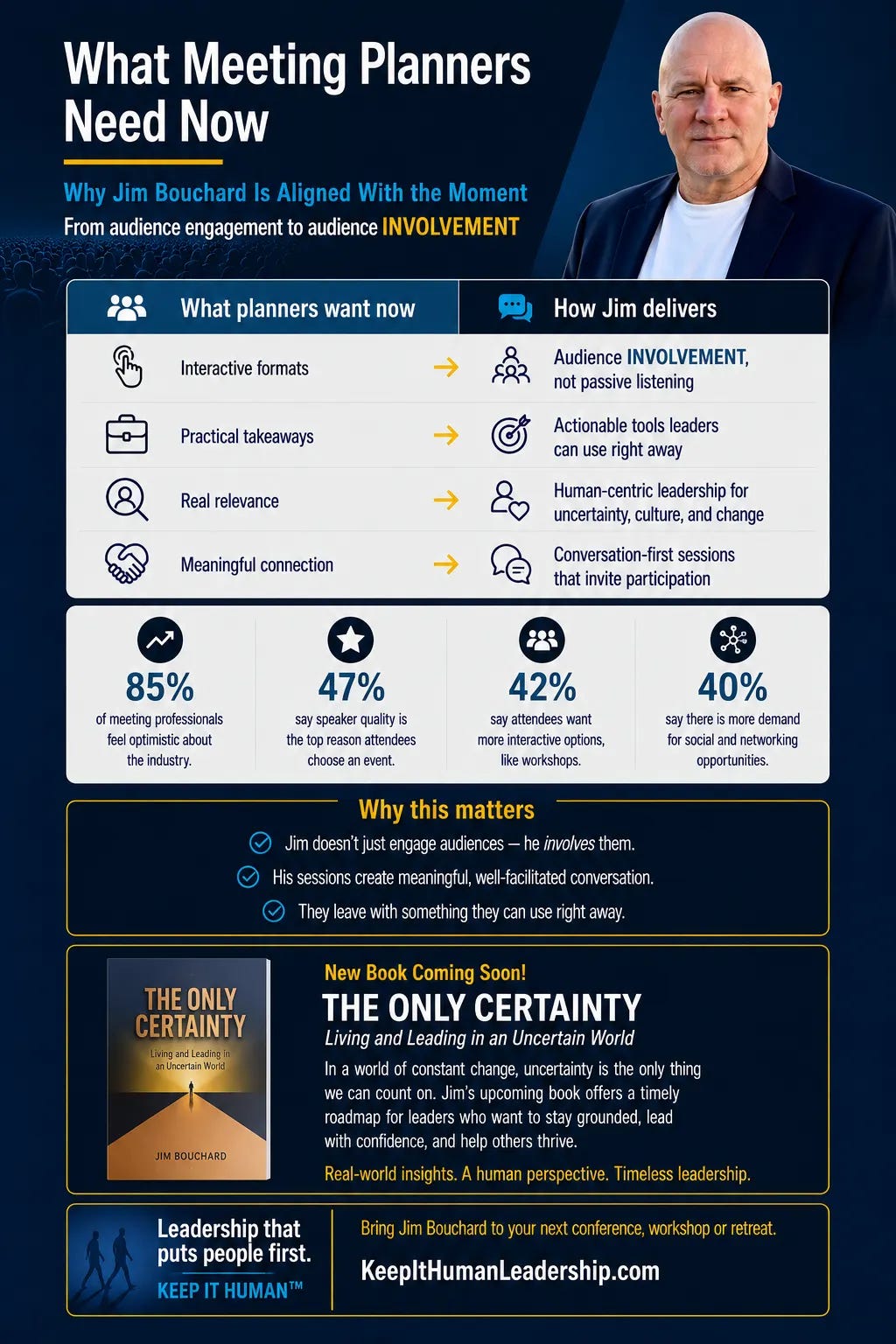
This is also the focus of Jim Bouchard’s upcoming book, The Only Certainty.
The book explores how leaders can face uncertainty without pretending it can be controlled, predicted, or eliminated. The goal is not to help people “get comfortable” with uncertainty. The goal is to help leaders build the clarity, trust, courage, and human connection people need to keep moving through it.
That work is already available now through The Only Certainty keynotes, workshops, and leadership retreats.
These sessions help leaders and teams:
Navigate uncertainty without defaulting to fear, cynicism, or false certainty.
Strengthen trust when people are divided, overwhelmed, or disengaged.
Practice human-centric leadership through the IEG disciplines: Inspire, Empower, Guide.
Turn disruption into a productive conversation instead of another source of anxiety.
Reconnect people to purpose, responsibility, and one another.
For organizations facing political tension, rapid change, AI disruption, burnout, or uncertainty about what comes next, this is a practical, human-centered way to help leaders work the problem together.
To explore a keynote, workshop, or retreat based on The Only Certainty, contact Alex Armstrong at Armstrong Speakers.
Booking:
https://www.armstrongspeakers.com
Closing Thought
The workplace cannot become one more arena where people practice contempt.
There are already enough places for that.
A healthy workplace should be one of the few places where people with different views, different pressures, different fears, and different hopes can still come together to do something useful.
That does not happen by accident.
It happens because leaders make it possible.