The Redline Report
This week’s theme: Efficiency without responsibility is becoming a leadership risk.

May 1, 2026
This week’s theme: Efficiency without responsibility is becoming a leadership risk.
The pressure to move faster, run leaner, and adopt AI more aggressively is not slowing down. In some boardrooms, that pressure is being framed as simple progress: fewer people, more automation, higher margins.
But leaders should be careful with that kind of certainty.
Efficiency is not the enemy. Neither is AI. The danger comes when efficiency becomes the whole strategy and people become the easiest line item to erase. That is where organizations cross the redline: when they confuse speed with wisdom, automation with judgment, and headcount reduction with leadership.
The human-centric challenge is not to resist change. It is to lead through change with courage, clarity, and responsibility.
That means asking better questions:
Are we using technology to elevate people or discard them?
Are we building trust or simply tracking activity?
Are we preparing people for what is next or leaving them to absorb the shock alone?
This week’s stories point to the same leadership truth: the future of work will not be secured by tools alone. It will be shaped by leaders who Inspire, Empower, and Guide people through uncertainty.
1. The Efficiency Trap: AI-Linked Layoffs Move From Warning Sign to Business Model
Source(s): Forbes, Reuters, Amazon, Business Insider
Source link(s):
Forbes: Jack Dorsey Bets 4,000 Jobs That AI Can Replace the Org Chart
Reuters: Amazon axes 16,000 jobs as it pushes AI and efficiency
Date: January–April 2026
Why it matters:
Major companies are making deep workforce cuts while pointing to AI, efficiency, and organizational redesign. Block reportedly reduced its workforce by roughly 40%, while Amazon confirmed approximately 16,000 corporate job cuts earlier this year. Whether every cut is directly “caused” by AI or not, the message landing with employees is clear: the tools being introduced to help the business may also be used to eliminate the people who built it.
Keep It Human Insight:
Efficiency becomes dangerous when it turns people into replaceable modules. Human-centric leaders can still make hard decisions, but they do not hide behind technology as if it absolves them of responsibility. The constructive move is to be clear about what is changing, honest about why, and active in helping people prepare for what comes next.
Traction level: High
Category: AI & Work
2. Singapore’s Tripartite Jobs Council Offers a More Human-Centric Model for AI Disruption
Source(s): Channel NewsAsia, The Online Citizen
Source link(s):
Date: April 30, 2026
Why it matters:
Singapore has formed a Tripartite Jobs Council bringing together government, unions, and employers to help workers and businesses navigate AI-driven job disruption. That matters because it shifts the conversation from “workers must figure this out on their own” to “leaders and institutions have a shared responsibility to prepare people for change.”
Keep It Human Insight:
This is the difference between disruption as abandonment and disruption as guidance. A human-centric organization does not simply announce the future and expect people to catch up. It builds pathways, support systems, and learning opportunities so people can move with the change instead of being crushed by it.
Traction level: Emerging
Category: Policy & Workforce
3. Gallup’s Workplace Data Keeps Challenging the Return-to-Office Certainty
Source(s): Gallup
Source link(s):
Date: April 2026
Why it matters:
Workplace engagement remains a major leadership concern, and Gallup’s ongoing research continues to show that how people experience work matters as much as where they perform it. The RTO debate is still too often driven by executive preference, old habits, and the desire to see people in the building rather than by trust, clarity, accountability, and performance.
Keep It Human Insight:
We’re still feeling out the effects of remote work versus face to face interaction. It seems the blend is what most people prefer. Physical presence is not the same as commitment. Human-centric leaders do not use the office as a substitute for trust. They define expectations clearly, build real accountability, and create connection intentionally: whether the team is remote, hybrid, or fully on-site.
Traction level: High
Category: Culture
4. Cloud Spending Surges While Human Readiness Struggles to Keep Up
Source(s): Synergy Research Group, Computer Weekly
Source link(s):
Synergy Research Group: Cloud Market Annual Revenue Run Rate Topped Half a Trillion Dollars in Q1
Computer Weekly: Cloud revenues up 35% YoY in a hot market that’s accelerating
Date: April 29–30, 2026
Why it matters:
Synergy Research Group reports that enterprise cloud infrastructure spending reached $129 billion in Q1, up more than $35 billion from the same quarter last year, with the annualized run rate now topping half a trillion dollars. Much of this surge is driven by AI and data infrastructure. The investment is real. The question is whether equivalent investment is being made in the human capacity to use these systems wisely.
Keep It Human Insight:
Organizations are pouring money into the pipes of intelligence. Now they have to invest in the people who turn that intelligence into judgment, service, ethics, and trust. The Keep It Human response is not less technology. It is better leadership around the technology.
Traction level: High
Category: AI & Work
5. Agentic AI Pushes Leaders From “Approvers” to Ethical Orchestrators
Source(s): McKinsey & Company
Source link(s):
Date: February–April 2026
Why it matters:
McKinsey’s 2026 technology research points to the rise of agentic AI: systems that do more than answer questions or generate content. They execute workflows, coordinate tasks, and increasingly influence decisions. That changes the leadership burden. Leaders are no longer simply approving work done by humans. They are orchestrating systems that may act at speed, scale, and distance from direct human judgment.
Keep It Human Insight:
The redline is the automation of judgment. A tool can optimize a workflow, but it cannot own the ethical consequences. Human-centric leaders need clear guardrails: where humans must stay in the loop, where accountability sits, and how decisions will be explained when they affect employees, customers, or communities.
Traction level: Medium
Category: Leadership & AI Governance
6. Human-Centric Management Is Moving From “Soft Skill” to Performance Strategy
Source(s): University of South Florida
Source link(s):
Date: April 9, 2026
Why it matters:
USF’s continuing education analysis frames human-centric management as a practical performance strategy, not a feel-good slogan. The central idea is simple: capable, focused, connected teams produce better outcomes than teams managed only through strict supervision and output metrics.
Keep It Human Insight:
This is the leadership opportunity hidden inside the disruption. As more work becomes automated, the competitive advantage shifts toward trust, connection, adaptability, and judgment. Leaders who Inspire, Empower, and Guide are not avoiding performance. They are creating the conditions where performance can actually happen.
We’ll be covering this in depth when “The Only Certainty” book launches. There are already several preview chapters available on the KIH Network Substack. Subscribe to stay in the loop!
Traction level: Emerging
Category: Leadership
7. The “Neocloud” Power Shift Raises New Questions About Dependence and Trust
Source(s): Synergy Research Group
Source link(s):
Date: April 29, 2026
Why it matters:
The cloud market is no longer only about traditional infrastructure providers. AI-focused players and specialized providers are becoming part of the core operating infrastructure for modern companies. That creates new dependencies, new risks, and new leadership questions about resilience, transparency, and control.
Keep It Human Insight:
When a vendor becomes part of your nervous system, procurement is no longer just a cost decision. Human-centric leaders should ask: What happens if this system fails? What happens if terms change? What happens if the tool begins shaping decisions more than leaders realize? Trust requires visibility.
Traction level: Medium
Category: Trust & Infrastructure
8. Mental Health and Loneliness Are Becoming Leadership Metrics
Source(s): Gallup, McKinsey.org
Source link(s):
Date: January–April 2026
Why it matters:
The pressure of AI adoption, workplace uncertainty, digital overload, and social disconnection is turning mental health from a personal wellness issue into an organizational performance issue. Leaders cannot treat burnout, loneliness, and anxiety as side effects outside the business. They shape retention, creativity, decision quality, and trust.
Keep It Human Insight:
If people need survival tactics just to get through the workweek, the answer is not another wellness app. Leaders have to examine pace, clarity, workload, connection, and psychological safety. The constructive move is to make human capacity part of the operating model, not an afterthought.
Traction level: High
Category: Culture & Well-being
9. Ethics and Compliance Are Re-Emerging as Resilience Strategies
Source(s): Ethisphere
Source link(s):
Date: March 2026
Why it matters:
Ethisphere continues to make the case that ethics and compliance are not merely defensive functions. They are part of durable performance, trust, and resilience. In a fast-moving AI economy, this matters even more. The faster organizations move, the more important it becomes to know what they will not compromise.
Keep It Human Insight:
Values are easy to claim when nothing is at stake. They become real when speed, profit, and pressure tempt leaders to cut corners. Human-centric leaders make ethics operational: clear standards, visible accountability, and a culture where people can raise concerns before small compromises become big failures.
Traction level: Medium
Category: Ethics
10. The Hidden Redline: Identity Strain in the Age of AI
Source(s): SmartErgo, EU-OSHA context
Source link(s):
Date: April 29, 2026
Why it matters:
As AI tools move deeper into white-collar work, employees are not only worried about tasks. They are worried about identity. People who built their value around expertise, analysis, writing, coding, legal drafting, or financial modeling may now feel that the ground under their professional dignity is shifting.
Keep It Human Insight:
This is where leaders need more than productivity dashboards. People are asking, “What am I worth now?” The Keep It Human response is to help employees reconnect with the human parts of work AI cannot own: judgment, empathy, responsibility, creativity, courage, and care. That is not sentimental. That is the new leadership work.
Traction level: Emerging
Category: Workforce
Patterns Worth Watching
1. Efficiency is becoming a moral test.
Organizations will keep using AI to reduce cost and increase speed. The leadership test is whether they do it with responsibility, transparency, and care: or simply celebrate the headcount reduction.
2. The burden of adaptation is shifting.
Singapore’s tripartite model shows one response: shared responsibility among institutions, employers, and workers. Many organizations still treat adaptation as a private employee problem. That gap will matter.
3. The office debate is really a trust debate.
RTO is often presented as a productivity issue. Underneath, it is usually about trust, accountability, control, and leadership capability. Be sure to read the KIH Special Feature below!
4. Human infrastructure is lagging behind technical infrastructure.
Cloud, AI, and automation investments are accelerating. Training, trust-building, ethical guardrails, and psychological safety are not always keeping pace.
5. The next leadership advantage is judgment.
Knowledge is being commoditized. Judgment, empathy, courage, trust, and ethical responsibility are becoming more valuable: not less.
Keep It Human Special Feature
The Real Currency of Leadership Is Trust
This week’s Redline points to a growing leadership tension: organizations are moving faster, adopting AI more aggressively, and making bigger decisions with less margin for error.
That makes trust more important, not less.
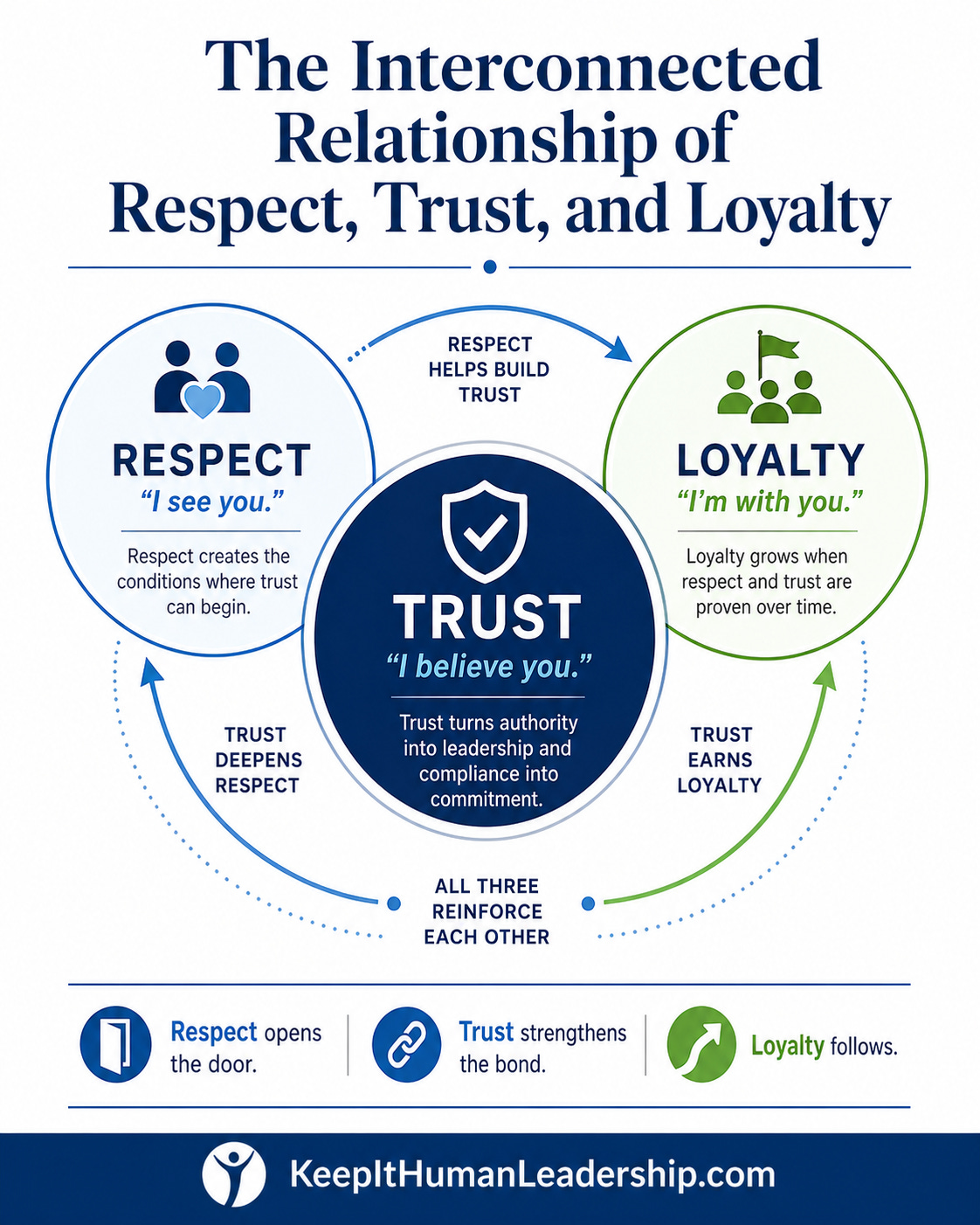
In this week’s Keep It Human article, The Real Currency of Leadership: Trust, Jim Bouchard explores why respect, trust, and loyalty are not soft ideals. They are essential leadership assets.
The order matters.
Respect says, “I see you.” Trust says, “I believe you.” Loyalty says, “I’m with you.”
You cannot demand loyalty from people you do not respect. You cannot expect trust from people who do not believe you care. And you cannot build a resilient culture by asking people to commit to leaders who have not earned that commitment.
That connects directly to this week’s stories. In an era of AI disruption, layoffs, remote-work tension, ethical pressure, and organizational uncertainty, trust is the difference between compliance and commitment.
People may obey authority because they have to.
They follow leadership because they choose to.
And that choice depends on trust.
Read the full article: The Real Currency of Leadership: Trust
Keep It Human Feature
The Leadership Question AI Cannot Answer
AI can answer a lot of questions.
It can summarize, sort, predict, write, classify, calculate, and automate. Increasingly, it can act. That is why so many organizations are rushing to deploy it.
But there is one question AI cannot answer for us:
What kind of organization are we becoming?
That question belongs to leaders.
Not because leaders have all the answers. They do not. The best ones know they do not. But leaders are responsible for holding the human question open when everyone else is chasing the efficiency answer.
It is easy to ask, “Can this be automated?”
It is harder to ask, “Should it be?”
It is easy to ask, “How many roles can we eliminate?”
It is harder to ask, “What responsibility do we have to the people who helped us get here?”
It is easy to ask, “How fast can we move?”
It is harder to ask, “What might we damage if we move without wisdom?”
That is the redline this week.
The leaders who thrive in this next era will not be the ones who reject AI. They will be the ones who refuse to surrender judgment to it. They will use tools boldly, but they will stay deeply accountable for the human consequences.
That is what it means to Keep It Human.
Closing Thought
The future of work is not waiting for us to feel ready.
AI will keep advancing. Markets will keep rewarding speed. Uncertainty will keep rising.
But uncertainty does not excuse leaders from responsibility. It demands more from them.
This is the work ahead: Inspire people with a clear and honest vision. Empower them with the tools, skills, and support to adapt. Guide them with ethical judgment when the path gets messy.
Simple. Not easy.
And absolutely necessary.
Jim Bouchard
Keep It Human™
The Only Certainty is coming soon : a practical guide for living, learning, and leading in an uncertain world.