I’ve worked with thousands of young and rising leaders over the past 15-plus years.
One question comes up again and again:
“What do I tell people when I really don’t know?”
Watch the video above…
The problem isn’t that leaders don’t have all the answers. The problem starts when we think we’re supposed to.
That fear usually pushes us toward three bad choices:
Pretend to be more certain than we really are.
Say nothing until we think we have all the answers.
Dump every concern and possibility onto the people around us.
None of those builds confidence. Silence, especially, rarely creates calm. It creates a vacuum. And people fill vacuums with rumors, fear, and imagination.
The monster is always bigger in the closet.
Sometimes we just need to open the door and let in a little light.
Confidence Is Not Certainty
True confidence isn’t knowing how everything is going to turn out. It’s being able to say:
“Here’s what I know. I don’t have every answer yet. But we’re going to work through this together.”
I learned a lot about this through martial arts.
You never know exactly what’s going to happen when you step into a fight. Confidence doesn’t come from certainty about the outcome.
It comes from training and preparation.
I don’t know if I’m going to win or lose. I do know I’ve trained. I do know I’m prepared to face what’s in front of me. And if I’m not prepared yet, I can learn.
That same idea applies to leadership.
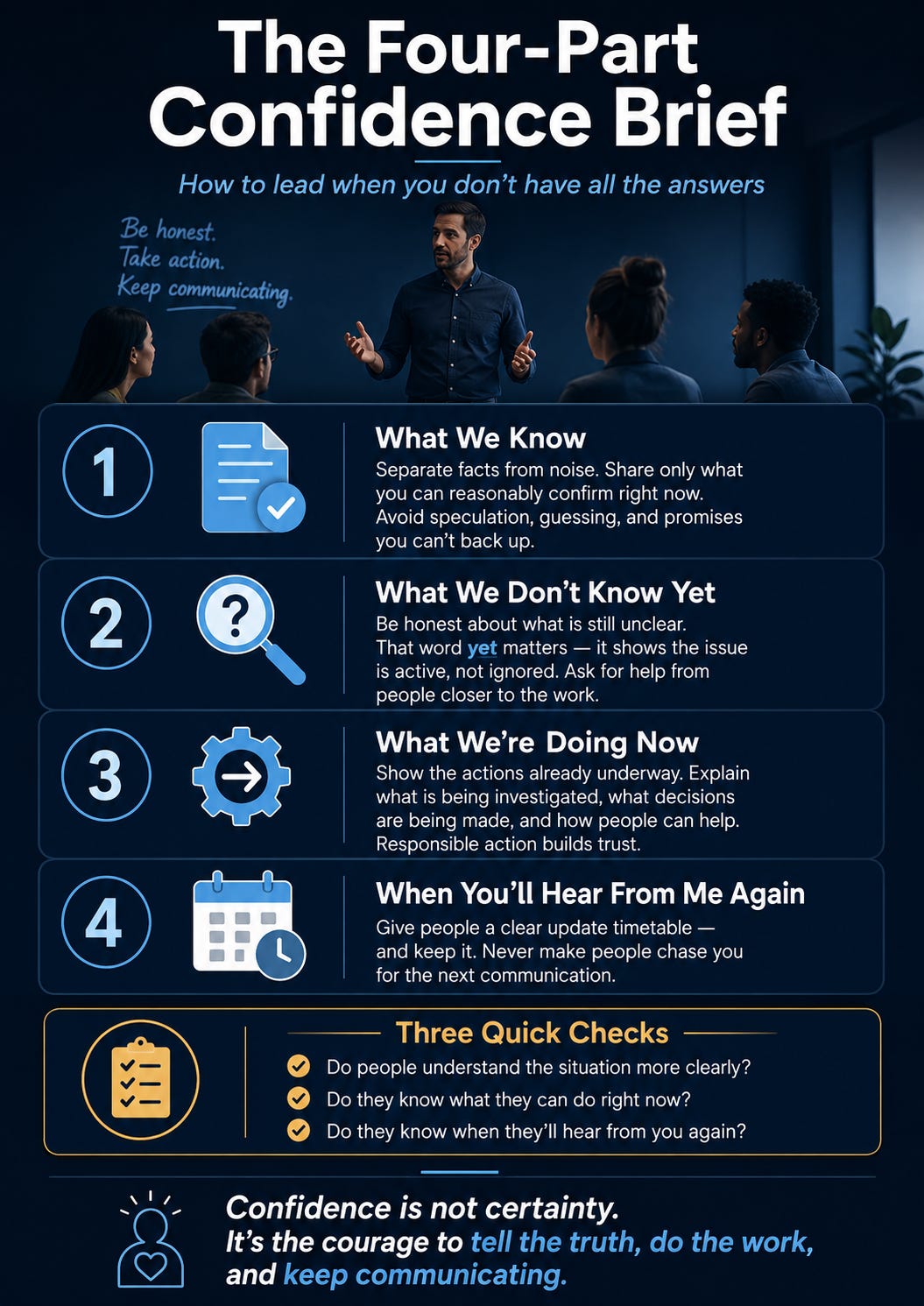
The Four-Part Confidence Brief
When you’re leading through uncertainty, give people four things.
1. What We Know
Separate facts from noise.
Avoid speculation, guessing, interpretation, and promises you can’t back up.
Tell people what you can reasonably confirm right now.
2. What We Don’t Know Yet
That word yet matters.
It tells people the question is still active. It hasn’t been ignored.
And don’t be afraid to ask for help.
Someone closer to the work may understand the situation better than you do. The higher you move in an organization, the more important that becomes.
You simply cannot know everything happening at every level.
Trust your people.
3. What We’re Doing Now
Show people the work already underway.
What are you investigating?
What decisions are being made?
What can people contribute?
The more people participate in solving the problem, the less you have to worry about getting them to “buy in.”
They’re already part of it.
People handle uncertainty much better when they can see evidence of responsible action.
4. When You’ll Hear From Me Again
This one is critical.
Give people a timetable.
Then keep it.
If you say you’ll update them Tuesday, update them Tuesday.
Not Wednesday.
Not Thursday.
And never make people chase you for the next update.
Three Questions
After you communicate with your team, ask yourself:
Do they understand the situation more clearly?
Do they know what they can do right now?
Do they know when they’ll hear from me again?
If the answer is yes to all three, you’re probably doing your job.
Leaders are not the people who have all the answers. Trust isn’t built by having all the answers either.
It’s built by showing people that you can face uncertainty with courage, honesty, confidence, and competence.
You don’t need all the answers to lead effectively.
You need the courage to tell the truth, do the work, and keep communicating with the people who trust in your leadership.
Want to go deeper?
We’ve built this framework into our Leadership Field Guides and into our live Keep It Human™ Leadership Labs.
Our first Lab, What Do I Tell Them?, is focused specifically on leading and communicating when you don’t have all the answers.
The best way to get the Field Guides, follow the Leadership Labs, and join us for future sessions is to subscribe.